Outdoor Sauna Planning Checklist
Installing an outdoor sauna in the UK is not complicated, but it is regulated. Planning permission, building regulations, drainage, electrics, and fire safety all apply — and the rules differ between England, Scotland, Wales, and Northern Ireland.
This checklist covers what you need to check before ordering, before breaking ground, and before signing off the installation. It is written for domestic garden saunas — typically timber outbuildings under 30m² used for personal use.
If you are unsure about any point, a pre-application enquiry with your local authority costs £100–£200 and is considerably cheaper than enforcement action after the fact.
Planning permission
Most domestic garden saunas are treated as outbuildings and fall under permitted development (PD) — meaning no formal planning application is needed, provided you stay within the limits. But PD is a conditional right, not a blanket exemption. The conditions differ by nation.
England and Wales
Under the GPDO 2015 (England) and the equivalent Welsh order, a garden sauna qualifies as permitted development if it meets all of the following:
- Single storey only
- Not forward of the principal elevation (no front gardens)
- Maximum eaves height: 2.5m
- Maximum overall height: 4m (dual-pitched roof) or 3m (any other roof)
- If any part is within 2m of a boundary: maximum overall height 2.5m
- Total area of all outbuildings and extensions must not exceed 50% of the curtilage
- No raised platforms above 0.3m (300mm) — this catches many deck designs
Wales adds one extra rule: any part of the building within 2m of the house must not exceed 1.5m in height.
Scotland
Scotland's rules under the GPDO (Scotland) Order 1992 (as amended) are similar but not identical:
- Must be at the rear of the house
- Maximum eaves height: 3m (higher than England/Wales)
- Maximum overall height: 4m
- If any part is within 1m of a boundary: maximum height 2.5m (note: 1m threshold, not 2m)
- Total outbuildings must not cover more than 50% of the rear curtilage
- Raised platforms can be up to 0.5m (more generous than England/Wales)
Northern Ireland
Under the Planning (General Permitted Development) Order (NI) 2015:
- Maximum overall height: 4m
- Eaves must not exceed 2.5m if within 2m of a boundary
- Must be at least 3.5m from any road boundary at the rear
- Total outbuildings must not cover more than 50% of the curtilage, and total outbuilding area must stay under 25m²
- Decks, balconies, verandas, and raised platforms are excluded from Class D permitted development entirely
Protected designations
Stricter rules apply in protected areas:
- England, Wales, and Northern Ireland: In AONBs, National Parks, and World Heritage Sites, any outbuilding more than 20m from the house is limited to a 10m² footprint
- Scotland: In conservation areas or the curtilage of a listed building, permitted development is restricted to a 4m² footprint
- Listed buildings: PD rights are generally removed. Any outbuilding within the curtilage of a listed building requires full planning permission and listed building consent. Unauthorised works can be a criminal offence
Local Article 4 directions can also remove PD rights entirely — check your local authority's interactive planning map before assuming PD applies.
If you are uncertain, a Lawful Development Certificate from your local authority provides formal confirmation that your project qualifies as permitted development. Our planning permission guide works through the rules for England, Scotland, Wales and Northern Ireland in more detail.
Building regulations
Planning permission and building regulations are separate regimes. A structure can be permitted development but still need building control sign-off — or vice versa.
Size thresholds
- Under 15m² internal area: Generally exempt from building regulations if detached, single storey, and no sleeping accommodation. In Northern Ireland, the building must also be at least 1m from the dwelling
- 15–30m²: Exempt only if at least 1m from any boundary, or constructed substantially of non-combustible materials
- Over 30m² or any sleeping accommodation: Full building regulations approval required
What still applies even when the shell is exempt
Even if your sauna structure falls under the size exemption, the services inside it are still regulated:
- Part P (electrical safety): Applies to any outbuilding receiving electricity from the dwelling. Sauna rooms are classified as "special locations" — all electrical work is notifiable
- Part J (combustion appliances): Applies to any wood-burning stove and flue installation
- Part H (drainage): Applies if you plumb in a shower, cold plunge, or any water discharge
- Part B (fire safety): Relevant for fire spread to boundaries, especially with combustible timber construction
Scotland: building warrant triggers
Scotland's system works differently. A detached building between 8m² and 30m² ancillary to a house does not require a building warrant — but this exemption specifically excludes buildings containing a fixed combustion appliance or a sanitary facility (shower, WC). Most wood-fired saunas and any sauna with a plumbed shower will therefore need a building warrant in Scotland.
The WC and shower trap
Adding a toilet, shower, or guest bed is the single most common reason a small outbuilding loses its building regulations exemption. It can also trigger council tax scrutiny if the building starts to look like a separate dwelling. If you want plumbing, factor building control into the project from the start.
Foundations and base
A sauna is lightweight compared with a house, but it concentrates load onto a small footprint — people, heater, stones, and benches all adding up. Most real-world failures are not structural collapse but movement, twist, water pooling, and rot. The base is a design decision, not an afterthought.
Base options
- Compacted gravel pad: The most popular domestic option. Excavate 100–150mm, lay a geotextile membrane, then 100–150mm of compacted MOT Type 1 hardcore. Good drainage, resistant to frost heave, and works well on clay soils prone to shrink/swell
- Reinforced concrete slab: 100–150mm thick on a compacted hardcore sub-base. Best for heavy pre-built cabins, year-round wet ground, or if you plan to add a cold plunge later
- Paving slabs on compacted sub-base: Suitable for smaller kit saunas, provided they are on mortar beds, not just sand
- Ground screws: Increasingly popular for sloped sites. Avoids concrete and maintains air circulation beneath the timber floor
- Timber decking: Structurally fine if heavy-duty, but watch the planning rules. In England and Wales, any raised platform above 0.3m (300mm) is not permitted development. In Northern Ireland, decks are excluded from PD entirely. Scotland allows up to 0.5m
Ground preparation
- Level the base to within ±5mm to ±10mm across the full footprint — most manufacturers specify this tolerance to prevent frame twist and jammed doors
- Remove all topsoil and vegetation down to undisturbed ground. Do not build on fill or soft spots
- On clay soils, moisture variation can affect foundations to a depth of around 0.75m — factor this into your base design, and be aware of nearby trees that can worsen shrink/swell
- Create a slight fall or perimeter drainage channel so surface water drains away from the timber walls
Floor insulation
Often overlooked: in the UK climate, an uninsulated floor creates a cold sink that makes it difficult to reach and maintain 80°C+ in winter. Consider 50mm XPS insulation beneath the sauna floor.
Drainage
Where the water goes is a compliance risk that many people underestimate. The rules depend on what kind of water you are disposing of.
Surface water (rain and splash)
Rainwater from the sauna roof and splash water from the area around it counts as surface water. The disposal priority under Approved Document H is: soakaway first, then watercourse, then surface water sewer.
A domestic soakaway must be at least 5m from any building or road, and at least 2.5m from any boundary. The base must remain above the water table.
Grey water (showers and cold plunge drainage)
Water from showers, cold plunges, and wash-downs is classified as foul drainage — not surface water. It cannot go into a rainwater soakaway.
The disposal priority under Part H is: public foul sewer first (where available), then private sewer to public sewer, then a septic tank or package treatment plant with a compliant drainage field designed to BS 6297:2007.
For off-mains properties, a drainage field must meet minimum distances: 10m from any watercourse, 15m from buildings, and 50m from boreholes or springs. You will need a percolation test to size the field correctly.
Cold plunge water: the hidden problem
If you chlorinate or chemically treat your cold plunge, disposal becomes sensitive. Chlorinated water cannot be discharged to ground or watercourses without authorisation. Chlorine dissipation can take at least five days depending on volume.
The safe default: drain a cold plunge to the foul sewer with water company approval, and do not discharge chemically treated water to a soakaway, garden, or watercourse.
Practical decision
Before ordering, decide whether your setup is "sauna only", "sauna plus hose-off area", or "sauna plus plumbed shower and cold plunge" — because each option has a different drainage route and a different compliance burden.
Electrical supply
Even wood-fired saunas usually need electricity for lighting, ventilation, an external light, or frost protection. All fixed wiring to a garden outbuilding falls under Part P.
Electric heaters
A typical domestic electric sauna heater runs at 4.5–9kW and requires a dedicated circuit from the consumer unit — usually 32A–63A depending on the heater size. This is not an extension lead job.
Before ordering a heater, confirm your home's supply can handle the load. Most UK homes run single-phase, which supports heaters up to around 8–9kW. Larger heaters may need a three-phase supply, which is uncommon domestically and expensive to install.
Cable and installation
- Underground cable must be Steel Wire Armoured (SWA). BS 7671 recommends a burial depth of 0.5m in domestic gardens to avoid accidental damage from gardening
- RCD protection is required on the supply circuit
- All fittings inside the sauna must be IP-rated and suitable for the temperature zone
- Controls and sensors should be mounted outside the hot room or low on the wall, per manufacturer instructions
Certification
Sauna rooms are classified as "special locations" under BS 7671 Section 703. All electrical work must be carried out and certified by a Competent Person Scheme electrician (NICEIC, NAPIT, or equivalent). You should receive both an Electrical Installation Certificate and a Building Regulations Compliance Certificate.
Uncertified electrical work voids warranties, can invalidate home insurance, and creates problems when selling the property.
Flue and chimney
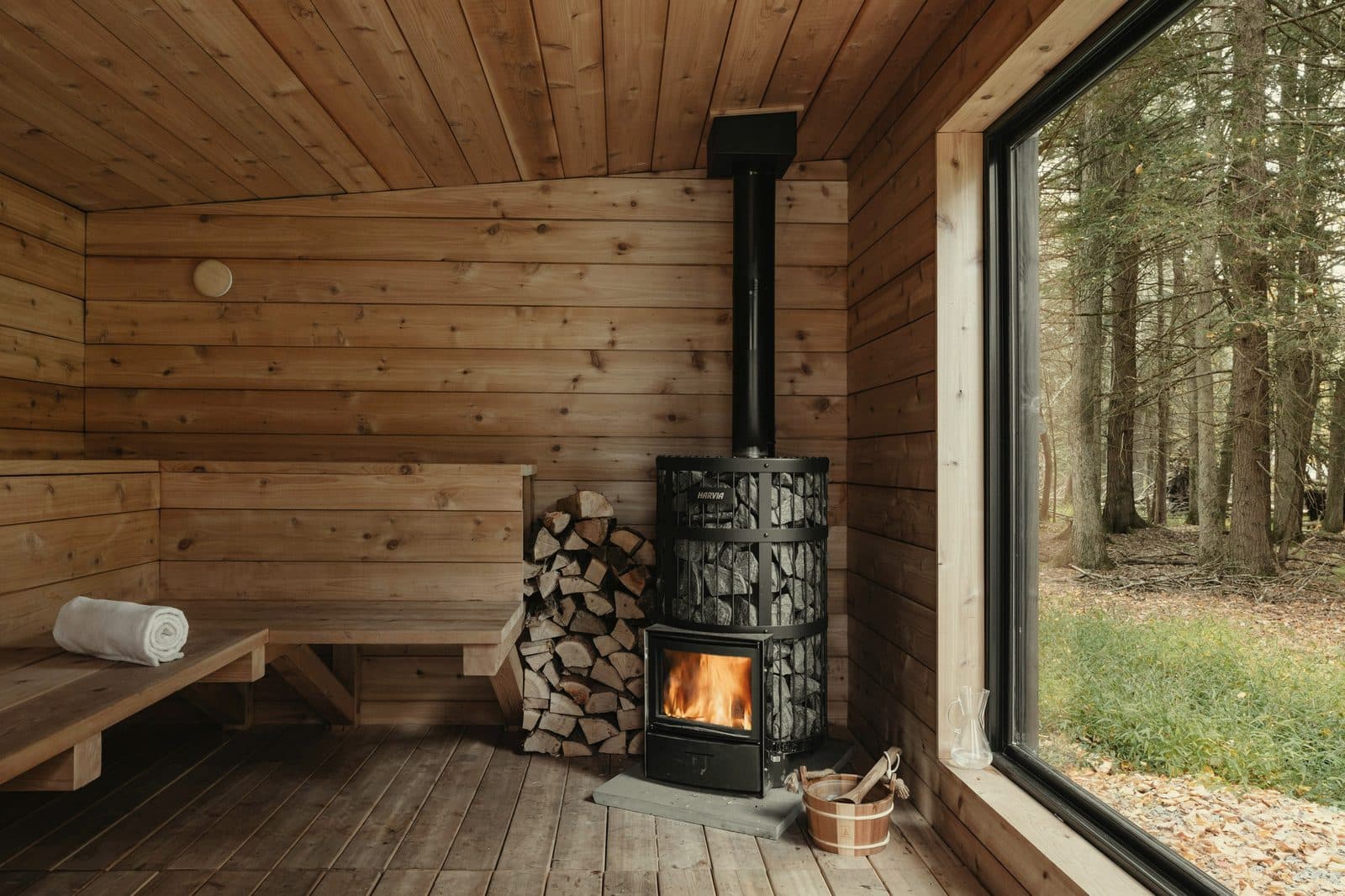
If you are installing a wood-fired sauna, the stove and flue system must comply with Approved Document J (England and Wales) or equivalent standards in Scotland and Northern Ireland.
Flue height and termination
Approved Document J Diagram 17 sets out the key clearances:
- Minimum total flue height from appliance to terminal: typically 4.5m for adequate draught
- If the flue is at or within 600mm of the roof ridge: terminate at least 600mm above the ridge
- If the flue is within 2.3m horizontally of an opening (window, rooflight, dormer): terminate at least 1,000mm above the top of that opening
- If the flue is within 2.3m of an adjoining building: terminate at least 600mm above any part of that building within 2.3m
Clearances to combustibles
- Single-skin flue pipe: minimum clearance of three times the flue diameter from combustible materials (e.g. a 150mm flue needs 450mm clearance)
- Twin-wall insulated flue: typically 50mm clearance, depending on certification
- The stove must sit on a non-combustible hearth projecting 150–300mm in front of the appliance door
Smoke control areas
In a designated smoke control area, you can only burn authorised smokeless fuel unless the appliance is on the DEFRA-exempt list — and no wood-fired sauna stove is on that list, in any UK nation. The test standard written for sauna stoves does not include particulate emission tests, so it cannot demonstrate what the exemption turns on. If you are in a smoke control area, an electric heater is the practical answer. Our guide to smoke control areas covers how to check whether your address is in one.
Air supply and CO alarm
Part J asks for a permanently open air vent sized at 550mm² per kW of output — permanently open in the room, rather than a sealed duct to the appliance. Fit a carbon monoxide alarm too, but know its status: the Part J requirement is limited to appliances in dwellings, and a detached garden sauna is not one. It is strongly advised rather than legally required, and it is the best thing you can put in the room.
Certification
Solid fuel installations are notifiable work. In England and Wales, a HETAS-registered installer can self-certify the work. Otherwise, you need building control sign-off. In Scotland, a fixed combustion appliance typically triggers a building warrant requirement regardless of building size.
Delivery and access
Access constraints are one of the most commonly overlooked problems. Measure everything before ordering.
Flat-pack delivery
Flat-pack saunas arrive as panels that need to be carried through to the site. You need a clear route of at least 900mm width through side passages, and panels can be up to 2.4m × 2.1m. Three or more tight 90-degree turns with long panels become difficult.
Fully assembled delivery
Pre-built saunas — especially barrel saunas — typically arrive on a flatbed and need a HIAB (lorry-mounted crane) or telehandler to lift them into position. Typical reach is 5–8m.
HIAB delivery requires:
- Firm hardstanding within the crane's lifting radius
- Outrigger space on both sides of the vehicle
- At least 6m clearance from overhead power lines (HSE guidance)
- A completed, level base ready before the delivery date
If a HIAB cannot reach the final position (typically because the sauna needs to go over the house), a dedicated city crane may be needed — budget approximately £800–£1,500 per day.
Weights to plan for
A typical barrel sauna weighs 400–1,500kg assembled. Larger cabin saunas can reach 2–3 tonnes. Confirm exact dimensions and weight with your supplier, and check that your access route and base can handle the load.
Insurance and neighbours
Two areas where people consistently get caught out: not telling the insurer, and not thinking about smoke.
Insurance
A permanent garden sauna is a "material fact" that affects your home insurance. You must notify your insurer. Expect questions about:
- Construction type (timber vs masonry)
- Rebuild value of the outbuilding
- Whether the heater is solid fuel or electric
- Whether the installation has been certified (Part P, HETAS, building control)
Some insurers apply higher premiums or specific conditions for wood-burning stoves in outbuildings. Others simply note it on the schedule with a small additional premium. Failure to disclose can void claims — not just for the sauna, but potentially for the whole policy.
Notify before installation, provide the rebuild value, and keep copies of all certification documents.
Smoke and statutory nuisance
Under the Environmental Protection Act 1990, councils can issue abatement orders if smoke from your sauna materially interferes with a neighbour's enjoyment of their property. A compliant flue and exempt appliance help legally, but persistent smoke blowing into adjacent gardens can still trigger enforcement through nuisance routes.
Position the flue as far from neighbouring windows and seating areas as practical, and burn only dry, seasoned wood to minimise smoke output.
Boundaries and Party Wall Act
A free-standing garden sauna does not usually trigger the Party Wall etc. Act 1996 unless you excavate within 3m of a neighbouring structure to a depth lower than their foundations. In practice, most sauna bases are shallow — but if significant excavation is needed close to a boundary wall, check whether a Party Wall Notice is required.
Good practice
Discuss your plans informally with neighbours before starting work — particularly if the sauna is close to the boundary or wood-fired. Avoid placing doors or windows directly overlooking neighbouring gardens at close range. Keep external lighting low-glare and on timers or PIR sensors.
Common mistakes
These are the errors that repeatedly cause rework, enforcement action, or insurance problems.
- Measuring height from the base, not natural ground level. The 2.5m boundary height limit is measured from the natural ground level, not from the top of your gravel pad or deck. A sauna that is 2.5m tall on a 200mm raised base is 2.7m — and technically needs planning permission
- Breaching the boundary proximity rule. Installing a 2.7–3.0m cabin 0.5m from the fence breaches the 2.5m-within-2m rule in England, Wales, and Northern Ireland (1m in Scotland)
- Assuming PD applies on protected land. In conservation areas, AONBs, and listed building curtilages, the rules are significantly stricter. Article 4 directions can remove PD entirely
- Building a deck without checking raised platform rules. A deck that exceeds 0.3m in England/Wales converts your project from PD to planning permission required. In Northern Ireland, decks are excluded from PD outright
- Treating the shell exemption as total exemption. Even when the building itself is exempt under the 15m²/30m² thresholds, Part P (electrics), Part J (stove and flue), and Part H (drainage) still apply
- Adding a WC or shower without building control. This is the most common trigger for losing building regulations exemption — and can also raise council tax questions about a separate dwelling
- Draining grey water into a rainwater soakaway. Shower and cold plunge water is foul drainage. It must go to the foul sewer or a compliant drainage field, not a surface water soakaway
- Discharging chlorinated cold plunge water to ground. Chlorinated water requires authorisation for disposal and cannot go into soakaways or watercourses without treatment
- Uncertified electrical work. Sauna rooms are "special locations" under BS 7671. Using an unregistered electrician or DIY wiring voids warranties and insurance, and creates problems at resale
- Assuming you can find an exempt stove for a smoke control area. No wood-fired sauna stove is on the DEFRA-exempt list, so the choice inside one of these zones is electric — not a different stove
- Not telling the insurer. An undisclosed outbuilding — especially one with a solid fuel appliance — is grounds for claim denial
- Skipping floor insulation. In a UK winter, an uninsulated floor creates a cold sink that makes reaching sauna temperatures difficult and wastes fuel
- No ventilation design. A sauna needs an intake vent near the stove and a diagonal exhaust vent. Without them, air quality drops, CO₂ rises, and timber rots faster
Pre-installation checklist
Before ordering
- Measure planned height at eaves and ridge, and distance to all boundaries
- Confirm total outbuilding coverage stays under 50% of your curtilage
- Check whether your property is listed, in a conservation area, AONB, National Park, or covered by an Article 4 direction
- If wood-fired: check whether you are in a smoke control area — no sauna stove is DEFRA-exempt, so being inside one points you to electric
- If in doubt: apply for a Lawful Development Certificate or submit a pre-application enquiry
- Confirm your electrical supply can handle the heater load (single-phase vs three-phase)
Before groundworks
- Choose base type based on soil conditions, weight of sauna, and drainage needs
- Level the base to within ±5mm tolerance
- Plan drainage route — decide between foul sewer connection and drainage field
- If grey water drainage is needed: run a percolation test and confirm soakaway distances (5m from buildings, 2.5m from boundaries)
- If excavating within 3m of a neighbouring structure: check Party Wall Act requirements
- Confirm delivery access — measure gates, side passages, and turning space
- If HIAB delivery: confirm hardstanding, outrigger space, and overhead clearance (6m from power lines)
After installation
- Obtain Part P Electrical Installation Certificate and Building Regulations Compliance Certificate
- If wood-fired: obtain HETAS certificate or building control sign-off
- Install a carbon monoxide alarm if using a solid fuel stove
- Notify home insurer — provide rebuild value, construction type, and fuel type
- Keep all certification documents for insurance and future resale
Next steps
If you are comparing builders to handle the installation, the guide to choosing a sauna builder covers what to look for, what questions to ask, and how to compare quotes.
If you have not tried a sauna yet and want to before committing to a build, the operator directory lists verified sauna experiences across the UK — you can filter by region, setting, and heat source.
Frequently asked questions
- Most garden saunas qualify as permitted development and do not need a planning application, provided they meet height, boundary distance, and coverage limits. In England and Wales, the key limits are 2.5m overall height within 2m of a boundary, 4m maximum height elsewhere (dual-pitched roof), and no more than 50% of the curtilage covered by outbuildings. Listed buildings, conservation areas, and AONBs have stricter rules. Check with your local authority if in doubt.
- The structure itself may be exempt if it is under 15m² with no sleeping accommodation, or under 30m² if at least 1m from any boundary. However, electrical work (Part P), wood-burning stove installations (Part J), and drainage (Part H) still require compliance and certification regardless of the building's size.
- Not in practice. Burning wood requires an appliance on the DEFRA-exempt list, and no wood-fired sauna stove is on it in any UK nation. Check whether your address falls in a smoke control area before ordering — if it does, an electric heater is the compliant option.
- Shower and cold plunge water is classified as foul drainage, not surface water. It must connect to the public foul sewer where available, or to a compliant drainage field designed to BS 6297:2007. It cannot go into a rainwater soakaway. Chlorinated cold plunge water needs special handling and should not be discharged to ground or watercourses.
- Yes. A permanent garden sauna is a material fact that affects your home insurance. Notify your insurer before installation, provide the rebuild value and fuel type, and keep copies of all electrical and stove certification. Failure to disclose can void claims — not just for the sauna, but potentially for the whole policy.
- A compacted gravel pad (100–150mm of MOT Type 1 on a geotextile membrane) is the most popular option for domestic garden saunas — it drains well, resists frost heave, and handles clay shrink/swell. Reinforced concrete slabs suit heavier cabins or wet sites. Whatever you choose, the surface must be level to within ±5mm to prevent frame twist.
- Electric heaters (4.5–9kW) need a dedicated 32A–63A circuit with SWA cable buried at 0.5m depth, RCD protection, and certification by a Part P registered electrician. Even wood-fired saunas typically need electrics for lighting and ventilation. All work must be certified with an Electrical Installation Certificate.
Do I need planning permission for a garden sauna in the UK?
Do building regulations apply to a small outdoor sauna?
Can I install a wood-fired sauna in a smoke control area?
Where does sauna shower and cold plunge water drain to?
Do I need to tell my home insurer about a garden sauna?
What base is best for an outdoor sauna?
What electrical supply does a garden sauna need?
Related guides
How to Choose the Right Sauna Builder
What to ask, what to look for, and common mistakes to avoid when commissioning a sauna build in the UK.
Getting startedWood-Fired vs Electric Sauna: What’s the Difference?
Practical comparison of wood-fired and electric saunas covering heat, running costs, installation, UK regulations, and which suits different settings.
Getting startedBeginner’s Guide to a Wood-Fired Sauna Visit
First wood-fired sauna visit? What to bring, how long to stay, session structure, cooling down, safety and etiquette — a practical UK guide for beginners.
Browse the directory
The monthly digest
New saunas and new guides, once a month. No spam, unsubscribe any time. Your address is used only for the digest — privacy notice.