Finnish Sauna Terms Explained: Löyly, Kiuas, Savusauna and More
This guide explains the Finnish words you will meet on UK sauna websites and inside a sauna, for people who want to know what they actually mean rather than nod along. Every entry was checked against Finnish sources — the state language institute, the Finnish Sauna Society, the Finnish Heritage Agency — rather than against other English-language sauna pages, which mostly copy each other.
That turned out to matter. Several of the most repeated "facts" in English sauna writing are wrong, including one about the most famous word of the lot. Where we could not pin something down, the guide says so instead of guessing.
Two notes before the words. Finnish stress is always on the first syllable, no matter how long the word. And the spelling is close to phonetic — one letter, one sound — which makes it far easier to say than it looks, once you know that y is not English "ee" and ä is not English "a".
Löyly — the word that matters most
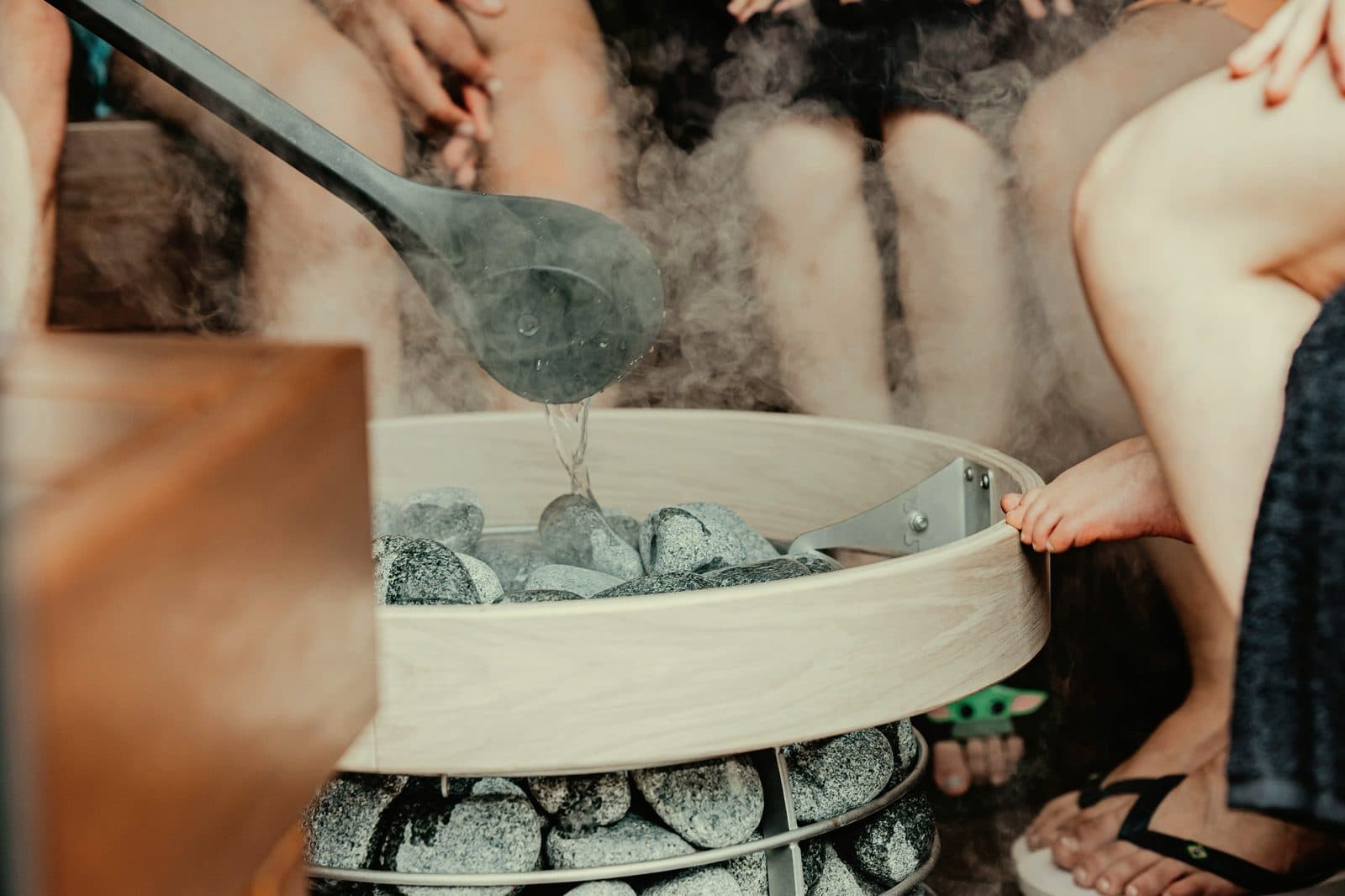
Löyly · say it LEU-lu · the steam, and the wave of heat that comes with it, when water is thrown onto the hot stones.
If you learn one Finnish sauna word, learn this one. It is not a synonym for steam in general — it is specifically what happens in a sauna when water hits the stones. In the plural, löylyt, it means the sauna bath itself, which is why a Finn might ask whether the löylyt were good.
Almost every English-language sauna page tells you that löyly means "spirit" or "the breath of life". That is not what it means in Finnish today. In modern Finnish it means the steam and the heat, and nothing more mystical than that.
What is true is more interesting. The word is genuinely ancient, and its relatives across the Finno-Ugric languages do carry that sense — in Estonian and Livonian it still means spirit or life as well as sauna steam, and the distant Hungarian relative lélek means soul. The Institute for the Languages of Finland concludes the original meaning was probably "life, soul, spirit", with the sauna sense being the later Finnish specialisation. UNESCO's own description of Finnish sauna culture splits the difference and calls it "the spirit or steam".
So the romantic version is not invented — it is a translation reaching back through the word's history. It just is not what a Finn means when they ask you to throw more löyly on.
The verb phrase is heittää löylyä, to throw löyly — or lyödä löylyä, literally to strike it, which the dictionary gives as equally correct. Note the ending: it is löylyä, not löyly, because you throw some löyly rather than the whole of it. What you will actually hear called out is lisää löylyä — "more löyly".
One verb to avoid. Löylyttää looks exactly like the verb form of löyly and it is not. In modern Finnish it means to thrash, trounce or beat someone up — it is a sports-report and politics word, as in a team löylyttää-ing its opponents. Even in the older dialect sense, the thing being löylytetty was the person or the malt being steamed, never the water. A reader who builds the obvious verb from the obvious noun will one day announce that they intend to give someone a hiding.
That connection is not accidental, incidentally. The noun carries the sense too: to get a löyly is to get a hiding. And verilöyly, literally "blood-löyly", is the ordinary Finnish word for a massacre.
Getting it wrong: the two common English attempts are "LOY-lee" and "LAY-loo". Both come from reading the letters as English. The öy is a single glide with no English equivalent — start at the vowel in "her" without the r, then round your lips hard.
Kiuas and kiuaskivet — the heater and the stones
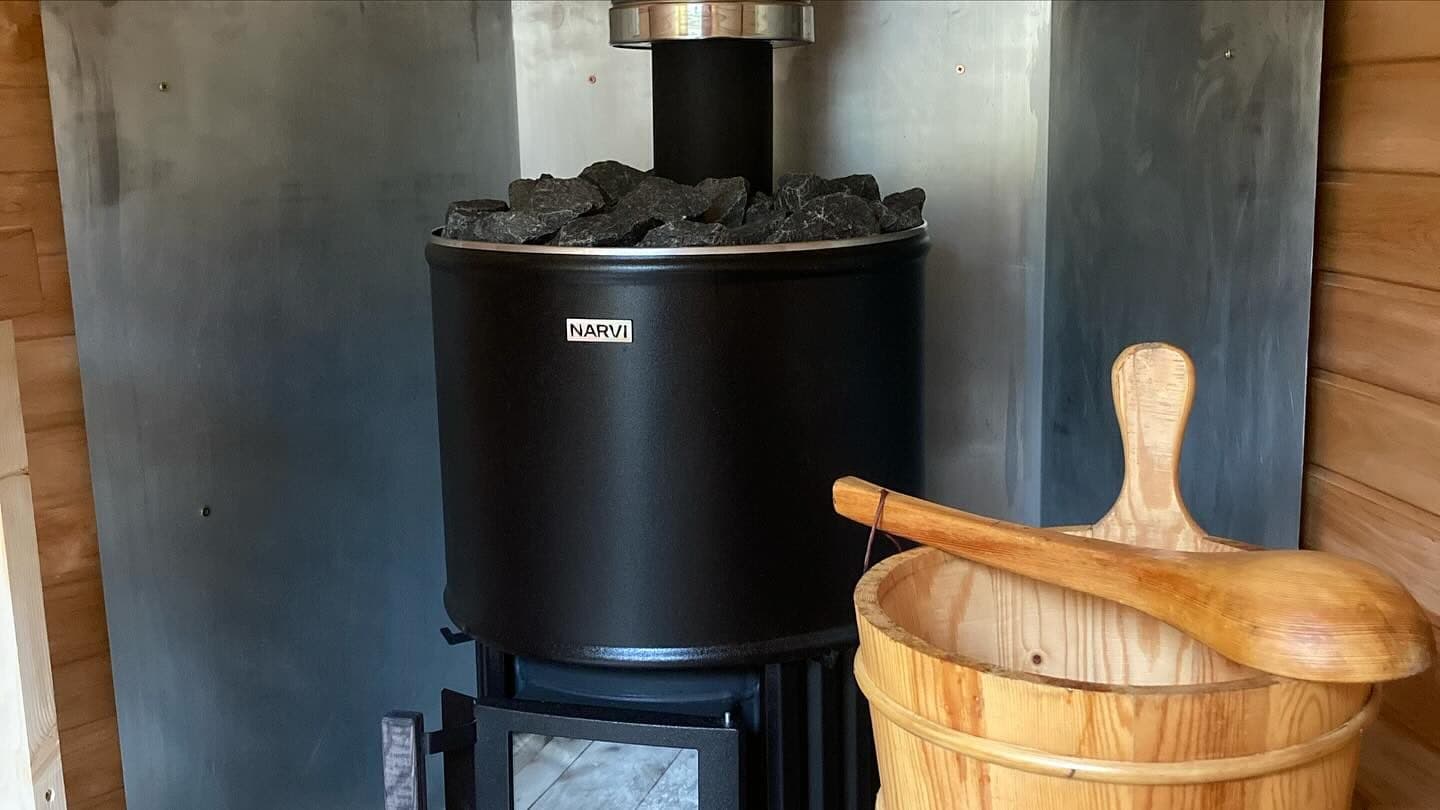
Kiuas · say it KEE-oo-as · the sauna heater, the whole unit.
Kiuaskivet · the sauna stones that sit on it.
In standard Finnish the kiuas is the heater as a whole — the dictionary defines it as a stove-like heater whose upper part carries a heat-storing bed of stones — and the stones have their own word. That distinction matters when you are buying, because the quantity of stone is the main driver of how much heat a sauna stores and how it behaves when you throw water on it.
But "kiuas = stove" is too tidy. The Finnish dialect dictionary records it also meaning the stone layer itself, a cottage or baking oven, and — this is the good one — a cairn of stones out in the landscape. That last sense survives in hiidenkiuas, a prehistoric burial cairn.
Which fits the etymology, now settled as a worn-down compound meaning "stone pile". The heater in an old smoke sauna was exactly that: a heap of rocks with a fire underneath. A Germanic origin was proposed in the 1980s and has since been rejected.
Two more you will meet on spec sheets:
- Puukiuas — a wood-burning heater.
- Sähkökiuas — an electric one.
But the more useful distinction, and the one Finnish sources actually lead with, is not wood versus electric:
- Kertalämmitteinen — "single-heating". You fire it, let it get up to temperature, then bathe in the stored heat. You cannot keep feeding it while you sit there. This is how a smoke sauna works.
- Jatkuvalämmitteinen — "continuous-heating". Kept burning while you bathe, so it needs fewer stones to hold heat.
Electric heaters have been essentially all continuous since the 1950s. If you are choosing a wood-fired sauna, this is the question that changes how an evening actually runs.
Vihta and vasta — the birch whisk, and the line across Finland
Vihta · say it VIH-ta, with the h breathed, not silent.
Vasta · say it VAHS-ta, the a as in "father".
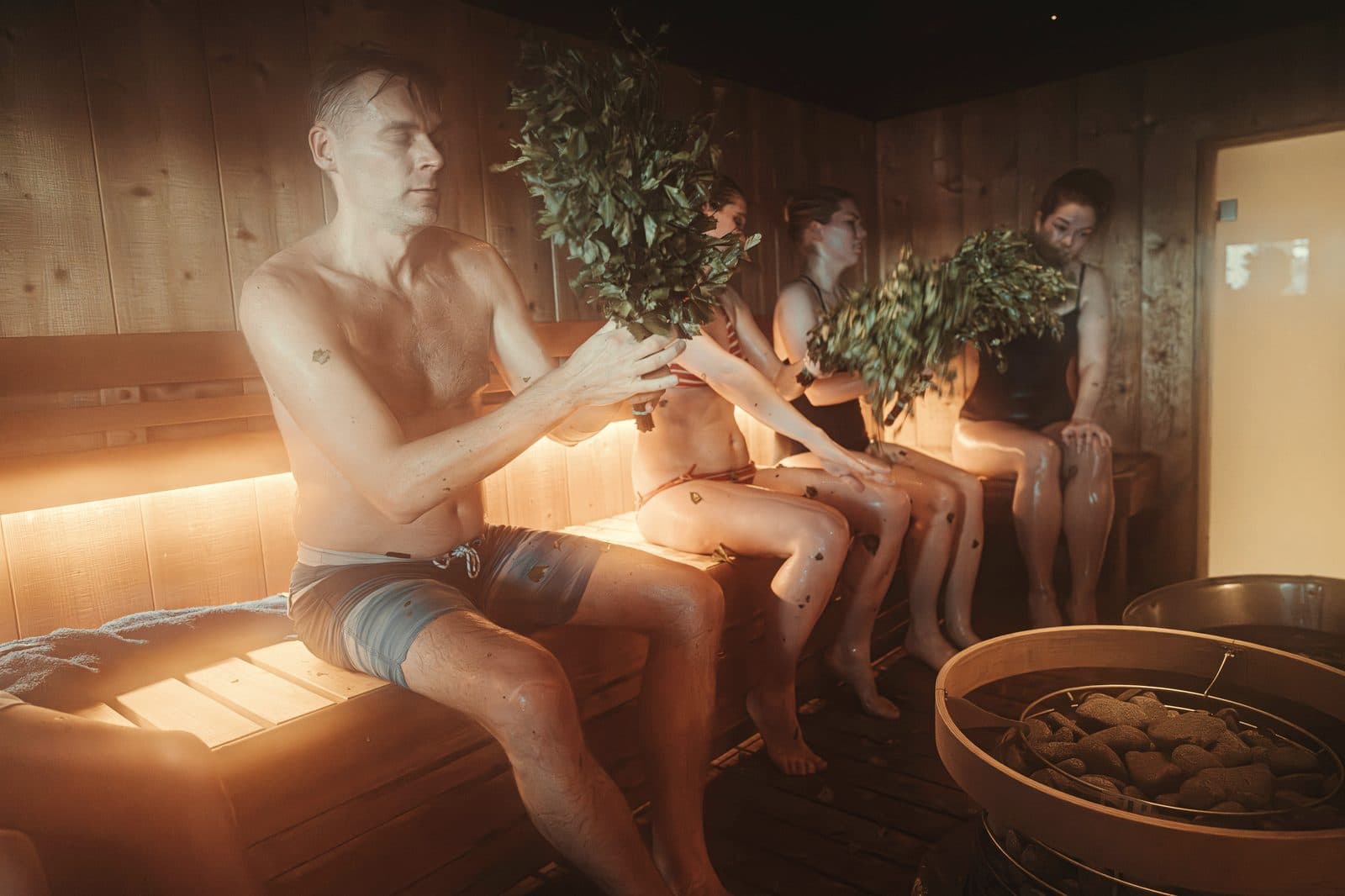
Both mean the same object: a bundle of leafy birch twigs, used to switch the skin in the sauna. Which word a Finn uses depends on where they are from, and this is one of the best-evidenced facts in the whole of Finnish sauna vocabulary.
Vihta is western. Vasta is eastern. The boundary runs roughly through Lake Päijänne, and the Finnish Sauna Society states it plainly: western Finns vihtovat, eastern Finns vastovat.
What makes this more than folklore is that somebody measured it. A survey run by Finland's public broadcaster with the University of Eastern Finland collected around 38,000 responses mapped by postcode. The resulting map sits in almost exactly the same place as one drawn in 1932. A century, and the line has barely moved. The researchers' explanation is that unlike most eastern and western word pairs, where standard Finnish eventually picked a winner, both words have equal standing — so neither was flattened out.
The neat version has an exception, though. The Institute for the Languages of Finland records vasta being used widely in central and northern Ostrobothnia and part of the far north — which are western dialect areas. The modern survey softens that, finding both words in use there. The historic record and the modern survey disagree; we are not going to pretend otherwise.
And the etymology runs backwards from what you would expect. Vasta, the eastern word, was long assumed to be a Russian borrowing; it is now traced to Germanic, and survives in modern Swedish as kvast, a broom. Vihta, the western word, is less clear but may be native Finnish, possibly related to vihma, fine rain. The word nearer Sweden is the possibly-native one; the word nearer Russia is the Germanic one.
It is not only the name that differs. The Finnish Sauna Society describes a construction difference too: in western Finland the whisk is bound using a bent birch branch, while in eastern Finland it is rolled with a twisted band. Both regions also disagree about which birch to use, with no resolution. They are made from midsummer to early July — before that the leaves are too soft, after that they fall off.
The whisking, incidentally, starts at the head.
One claim we are not printing: several UK retailers state that a vihta and a vasta differ in size and shape — one flat and around 50cm, the other round and around 75cm. We could not find that in any Finnish source, institutional or otherwise. Treat it as unverified.
Savusauna — the smoke sauna, and why it is cooler than you have been told
Savusauna · say it SAH-voo-SOW-na · a wood-heated sauna with no chimney.
The fire burns for hours with the smoke filling the room and escaping through a vent and the door. When the wood has burned down, the smoke is cleared, the soot-blackened room is aired, and you bathe in the heat held by the stones and the structure. It is single-heating by definition — you cannot fire it while you are in it.
English-language sauna writing routinely presents the savusauna as the hottest and most extreme form of sauna. The Finnish Sauna Society's own guidance says the opposite. It gives a target of 60–80°C — deliberately cooler than a modern sauna — and warns that getting a chimneyless sauna too hot "will ruin it". The appeal is soft löyly and long, even heat, not peak temperature.
Their guidance is specific in other ways worth knowing: allow at least an hour after the embers die for the smoke to clear, and cut the wood small, because the smallest splits produce a fraction of the carbon monoxide of large ones.
The chimneyless design dominated Finnish sauna culture until roughly the 1930s, then lost out to chimney stoves and later electric heaters — faster, cleaner, usable the same day, and compatible with indoor plumbing. It is genuinely coming back: Finland's public broadcaster reported the count roughly tripling over two decades, on the authority of the country's leading smoke-sauna specialist. But every figure in circulation is an estimate from a small circle of the same people, and one English-language site quotes a number five to twenty times higher than any Finnish source. Treat all of them as ranges.
A related word: räppänä — the smoke vent or hatch in the wall. Its relatives turn up in Karelian, Estonian, Livonian and further afield, all meaning a smoke opening.
The room, the benches and the rest of the building
Two useful things to know before you buy anything. In Finland, sauna often means the whole building rather than the hot room, which has its own word. And sauna also means the act of bathing — the dictionary's own example, meillä on sauna kerran viikossa, means "we have a sauna once a week" in the sense of bathing, not of owning one. English has no verb for this, which is why "have a sauna" sits awkwardly.
- Löylyhuone · LEU-lu-hoo-oh-neh · the hot room itself, literally the "löyly room". UK sellers tend to call the whole cabin a sauna, which loses this distinction.
- Lauteet · LOW-tayt · the tiered platform you sit on. "Benches" is the usual English gloss and it undersells it — the dictionary defines it as a raised platform structure built into the sauna for taking löyly, which is a different idea from a bench you happen to sit on. Normally plural, though a singular laude does exist and shows up in the compounds for the individual tiers: ylälaude (upper), alalaude (lower), jalkalaude (the footboard). You will meet it as lauteilla, "on the lauteet".
- Pesuhuone · the washing room.
- Pukuhuone · the changing room.
A Finnish rule of thumb on proportions, which UK garden saunas rarely follow: the washing room around half again the size of the hot room, and the changing room around twice it. Finnish sauna buildings devote much more space to what happens either side of the heat than British ones do.

Water, cold and the bits you hold
- Kiulu · KYOO-loo · the water vessel. Not a bucket — Finnish keeps those apart. A kiulu has a single upright lug rather than a swing handle; a bucket with a bail handle is a sanko or ämpäri. It is also not originally a sauna object at all: the dictionary's lead example is a milking pail, and the word is a Scandinavian borrowing. UK retail copy that calls it "the traditional sauna bucket" has it backwards on both counts.
- Kauha · KOW-ha, with the h fully sounded · the ladle. A completely separate word and object from the kiulu, with a different history again — this one borrowed from Baltic. The sauna-specific term is löylykauha. They are sold as a matching pair, which is probably why English sources muddle them.
- Avanto · AH-van-toh · a hole in the ice. Not specifically a swimming hole — it is a hole in the ice however it got there, and in Finland it is cut at least as often for ice fishing as for swimming. Watch the grammar shift: avannossa, "in the hole".
- Palju · PAHL-yoo · a tub. The Finnish dictionary's headline example is a pyykkipalju — a laundry tub — and it marks the hot-tub sense as a specialised secondary meaning. The unambiguous words for the outdoor hot tub UK sites call a "palju" are kylpypalju or kylpytynnyri. The word travelled a long way to get here: French, then Low German, then Swedish, then Finnish.
- Vilvoitella · to cool off between rounds. The cooling is treated as part of the sauna, not an interval in it.
And one correction that matters if you ever use the word out loud. English sauna sites routinely write about "avanto swimming", and treat avanto as the name of the practice. It is not — it is a noun for a hole in ice, and "avanto swimming" is an English coinage rather than Finnish. The dialect record makes the point better than any argument: of roughly two dozen recorded compounds built on avanto, every one is about work — the laundry hole, the log-floating hole, the water-drawing hole, the seine-netting holes. Not one is about bathing. The traditional hole in the ice was infrastructure.
The Finnish for the activity is either:
- Avantouinti · swimming in an avanto — so it needs ice.
- Talviuinti · winter swimming, the broader word: any outdoor swimming in cold water, ice or no ice, including a heated outdoor pool. Roughly, water below 10°C.
Finland's national outdoor recreation association prefers talviuinti, on the sensible grounds that the ice-hole season is short and the swimming is not.
People, spirits and manners
- Saunoa · SOW-no-ah · the verb, to have a sauna. What you will actually hear is saunotaan — "let's have a sauna".
- Saunoja · a person having one.
- Saunarauha · SOW-na-ROW-ha · "sauna peace". The single most useful etiquette word there is. The Finnish Sauna Society's rules make it concrete: a peaceful atmosphere takes priority, and competitions to see who can stand the most heat are banned outright.
- Saunailta · SOW-na-il-ta, four syllables — not "sow-NYE-lta" · a sauna evening, and a real fixed term rather than a description. The dictionary defines it as a social evening of which a sauna forms part, and its one example is a club's saunailta. Having a sauna by yourself on a Tuesday is not a saunailta. In Finnish working life it is a standard fixture — closer to the office away-day than to a night in.
- Yleinen sauna · a public sauna — and specifically one anyone can use for a fee, which is not quite the British sense of "public". These were commercial bathhouses, and a working-class necessity: Helsinki had more than 120 in the 1940s, when few homes had a bathroom, and fewer than ten by the early 1980s. Note that Finnish sauna specialists consider yleinen sauna a loose term, since it can also cover an apartment block's shared sauna that you certainly cannot walk into. If you mean genuinely open to all, julkinen sauna is the precise word.
- Kyly · the Karelian and eastern word for a sauna. If you see it, it is not a misspelling.
Saunatonttu — and the older, less friendly version
Saunatonttu is usually translated as the sauna elf or gnome, a benign little figure who lives in the sauna. Almost everything about that sentence needs qualifying.
The belief is old. The name is borrowed. A guardian spirit of the sauna is documented in bulk in the Finnish folklore archives, from collections made in the 1890s onward describing pre-industrial belief. But tonttu itself is a Swedish loanword, from tomtegubbe — literally "the old man of the plot". The Institute for the Languages of Finland says plainly that the tonttu tradition is not old Finno-Ugric but was taken from the Swedes in the modern era; Finland's public broadcaster, drawing on the same folklore archive, calls the saunatonttu an ancient belief. Those two are not quite reconcilable and we are not going to pretend otherwise. The older, native term is saunan haltija — the sauna's guardian — and it is the one the national heritage inventory leads with.
It was not cute. The archive figures are bearded men, invisible presences, or, in one description, like hairy devils. It enforced behaviour through fear: Finnish literature includes a tale of a woman skinned for misbehaving in a sauna. The cheerful red-hatted version is the Christmas tonttu, which has only been familiar in Finnish folklore for about a century and has been back-projected onto the older figure.
And it was as often female as male. The archive records female spirits with their own names and jobs, including one associated with the healing power of löyly and one linked to midwives; one 1930s account describes a white-clad woman combing her hair in the sauna. The "little grey-coated old man" is one recorded form among several.
The practical reading is that the taboos did a job: with a smoke sauna hot for only a limited window, rules about bathing late rationed a scarce resource across a whole household. Nobody leaves a sauna turn for the saunatonttu now.
One word of warning. Tonttu has a second, entirely current colloquial meaning: an idiot. Senkin tonttu is not a compliment.
Pefletti
The little seat cover you sit on. It sounds convincingly traditional and is nothing of the kind: it is a 20th-century coinage from peffa, Finnish slang for backside, given a mock-English -let ending on the model of words like "armlet".
It is also, still, a live trademark — registered in 1991 and held by a Finnish paper company. The Finnish dictionary lists pefletti as an ordinary lower-case noun while the trademark is the capitalised form, which is about as clear a picture of a brand name going generic as you could ask for. The free, untrademarked word is laudeliina, a cloth seat cover; the dictionary treats it as the cloth variety of pefletti rather than a separate object. The Finnish Sauna Society once pushed lauteinen as a replacement. It did not take — the word is not in the dictionary.
Five things English-language sauna sites get wrong
These are the claims we set out to verify and could not, or could actively disprove.
1. "Finland has more saunas than cars"
It does not. Statistics Finland recorded 3,819,975 registered passenger cars at the end of 2025. Every sauna estimate in circulation is lower than that, including the inflated ones.
2. "There are 3 million saunas in Finland"
Nobody actually knows. There has been no systematic count since 1994. The official building statistics give around 2 million, but they explicitly exclude free-standing sauna buildings — which is exactly the lakeside cottage sauna the whole culture rests on. The 3.3 million figure everyone quotes comes from Finland's own UNESCO submission, and traces back to a single 2010 magazine estimate whose method was never published. The best independent reconstruction lands near 2.66 million. Finland's population, for the record, was 5,650,933 in March 2026.
3. "Sauna is the only Finnish word in English"
Not quite, and there is a better story underneath. Sisu is also in English dictionaries, along with a handful of technical borrowings.
More striking: where "sauna" itself comes from is an open question, and the two sides of it are both published by the same Finnish institute. Its etymological dictionary treats the word as inherited, and lists a North Sámi cognate meaning a pit dug in snow. Its public Q&A pages carry a newer proposal from the linguist Petri Kallio that sauna is instead a very old Germanic loanword, originally meaning something like a stone pile or ruined stove — a proposal it says has gained support.
The two have not been reconciled, so we are not going to pick one. But note what the second would mean if it holds: sauna and kiuas would both trace back to the same image, a heap of stones — and the most famous Finnish word in the world would have been borrowed into Finnish before Finnish lent it to everyone else.
4. "UNESCO recognises the Finnish sauna"
UNESCO inscribed "Sauna culture in Finland" in 2020 — the culture and practice, not the building. Two things usually go missing. First, Estonia got there six years earlier: "Smoke sauna tradition in Võromaa" was inscribed in 2014. Second, the Finnish inscription explicitly lists saunas as coming in many forms — "electric, wood-heated, smoke and infra-red" — and says there is no hierarchy among them. Anyone citing UNESCO to argue that some sauna is not a real sauna is citing a text that says the opposite.
5. "Sauna sweats out toxins"
The British Sauna Society puts it bluntly: your liver and kidneys do that, and sweat plays a small supporting role. The point is worth making here because of what the Finnish Sauna Society's own health page contains — circulation, relaxation, muscle relief, blood pressure, bronchial effects — and what it does not: no mention of detoxification, calorie burning or weight loss at all. It does warn about things UK sites rarely mention, including that alcohol is implicated in around half of sauna deaths.
One more we are deliberately not answering: how old the sauna is. Figures from 7000 BC onwards get quoted freely, always without a source. Timber saunas rot and burn, so the archaeological record is thin, and the honest Finnish position on whether the sauna is a Finnish or Estonian invention is that nobody knows.
How to say any of it
Finnish pronunciation is more regular than English and the rules are few. From the University of Helsinki's phonetics guidance for learners:
- Stress is always on the first syllable, however long the word.
- One letter, one sound, near enough. What you see is what you say.
- Length changes the word. A doubled vowel or consonant is held longer, and it is not decorative — tuli, tuuli and tulli are three different words.
- ä, ö and y are the hard ones. ä is the vowel in "cat". ö is near the vowel in "her" without the r. y is not "ee" — say "ee" and then round your lips hard.
- Finnish intonation falls at the end of a sentence, including questions. An English rising question sounds distinctly foreign.
And the one everybody gets wrong: sauna rhymes with "how", not with "saw". SOW-na.
What we could not pin down
A guide like this is only as good as what it admits to. Some of it is sourced to the Finnish state dictionary and the etymological and dialect dictionaries; some is not.
- Palju's history as an outdoor hot tub. It appears to be a late-twentieth-century development, but we found that stated only on manufacturer and hire-company pages, so we have not put a date on it. What is solid is that the dictionary marks the bathing sense as specialised, which itself points to it being the later meaning.
- The claim that vihta and vasta differ in size and shape appears only on retailer sites. Unverified, and we have left it out.
- There is a widely circulated story that pefletti's replacement was chosen by public competition in the early 1990s. We could trace it only to encyclopedia-derived pages, so it is not stated above as fact.
- Anything about sauna sausage or post-sauna beer — genuinely part of the culture, but outside what we checked, so not stated here as fact.
- No dialect record for palju or pefletti exists to consult: the Finnish dialect dictionary is only published as far as the letter N. That is a gap in the record, not evidence that the words do not vary.
If you speak Finnish and something here is wrong, we would rather know.
Next steps
The one principle worth taking away is not a word but a sentence, from the Finnish Heritage Agency's own description of sauna practice: everyone is the expert on their own sauna session.
Finnish sources describe a rhythm — five to fifteen minutes of heat, then cooling, repeated — and a set of norms rather than rules. Bathing is traditionally naked, on the reasoning that it strips away the markers of status; sessions are traditionally divided by gender, with mixed bathing increasingly common; and the governing idea is saunarauha, sauna peace. What Finnish sources do not do is issue the long lists of etiquette commandments that English sauna writing tends to.
If you want to hear the vocabulary in use rather than read it, the listings below describe themselves in these terms. Our beginner's guide covers a first visit in practical detail, and the cold water guide covers what happens after the heat.
Frequently asked questions
- In modern Finnish, löyly means the steam and the burst of heat released when water is thrown onto hot sauna stones. English sauna sites often translate it as 'spirit' or 'breath of life', which is not what it means today — though the word is ancient and its relatives in Estonian, Livonian and Hungarian do carry senses of spirit, breath and soul. The Institute for the Languages of Finland concludes the original meaning was probably 'life, soul, spirit', with the sauna sense being a later Finnish specialisation.
- They are the same thing — a birch whisk — and which word is used depends on the region. Vihta is western Finnish, vasta is eastern, with the boundary running roughly through Lake Päijänne. A survey of around 38,000 people mapped the line in almost the same place as a map drawn in 1932. There is also a construction difference: western whisks are bound with a bent birch branch, eastern ones rolled with a twisted band. Claims that the two differ in size or shape appear only on retailer sites and are unverified.
- Roughly LEU-lu, with the stress on the first syllable. The öy is a single glide with no English equivalent — start at the vowel in 'her' without the r, then round your lips tightly. The two common English mistakes are 'LOY-lee' and 'LAY-loo', both of which come from reading the letters as if they were English. Finnish stress is always on the first syllable.
- No — it is usually cooler. The Finnish Sauna Society's own guidance for smoke saunas gives a target of 60 to 80°C and warns that overheating a chimneyless sauna will ruin it. The appeal is soft löyly and long, even heat rather than peak temperature. English-language sauna writing often presents the savusauna as the most extreme form of sauna, which is the opposite of what Finnish sources say.
- No. Statistics Finland recorded 3,819,975 registered passenger cars at the end of 2025, which is higher than any sauna estimate in circulation. The sauna figure itself is uncertain: there has been no systematic count since 1994, official building statistics exclude free-standing sauna buildings, and the widely quoted 3.3 million traces to a single 2010 estimate whose method was never published.
- Sauna culture in Finland was inscribed on UNESCO's Representative List of the Intangible Cultural Heritage of Humanity in 2020. What is inscribed is the culture and practice rather than the building. Estonia's smoke sauna tradition in Võromaa was inscribed earlier, in 2014. The Finnish inscription explicitly describes saunas as taking many forms — electric, wood-heated, smoke and infra-red — with no hierarchy among them.
What does löyly mean?
What is the difference between a vihta and a vasta?
How do you pronounce löyly?
Is a smoke sauna hotter than a normal sauna?
Does Finland really have more saunas than cars?
Is the sauna on the UNESCO heritage list?
Saunas run on Finnish and Nordic lines
Operators who describe their sauna in these terms. Worth a visit if you want to hear the vocabulary used rather than read it.

London, London
Skuna Sauna Boat is a wood-fired floating sauna moored at West India Quay, Canary Wharf, operating two docked sauna…

Worthing, South East
Fire, Salt & Sea is a Finnish-style, wood-fired sauna permanently sited on the pebbles of Worthing seafront, opposite…

Betchworth, South East
Savu is a wood-fired Finnish-style sauna operating at Buckland Park Lake in the Surrey Hills, between Reigate and…

Liverpool, North West
Wyld Sauna is the UK's first public floating sauna, permanently moored at Princes Dock on the Liverpool Waterfront. The…

Manchester, North West
Kontrast is a community sauna and ice bath café housed in a railway arch next to Angel Meadows in central Manchester.…

Huddersfield, Yorkshire & Humber
iglu sauna's Slaithwaite pop-up sits on a strip of land between the canal and the River Colne at Upper Mills,…
Related guides
Beginner’s Guide to a Wood-Fired Sauna Visit
First wood-fired sauna visit? What to bring, how long to stay, session structure, cooling down, safety and etiquette — a practical UK guide for beginners.
Getting startedWood-Fired vs Electric Sauna: What’s the Difference?
Practical comparison of wood-fired and electric saunas covering heat, running costs, installation, UK regulations, and which suits different settings.
Getting startedCold Water After Sauna: Contrast Bathing Basics
What contrast bathing is, why people do it, what happens to your body, and how to start safely — a practical UK guide.
Browse the directory
The monthly digest
New saunas and new guides, once a month. No spam, unsubscribe any time.